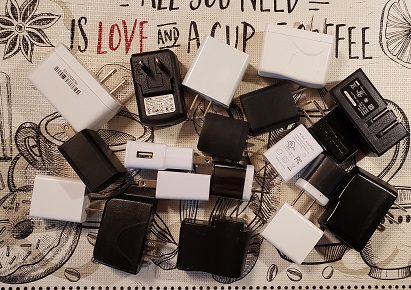
I have also increased my inventory to almost a hundred devices that are powered from a USB connector. The quality of the cable and the length of the cable are huge factors in having reliable device. After trying a number of things, my solution is to provide a power supply at the device that can convert 12-24V into 5V with a USB connection. (POE is an option, but at present most of my devices are NOT POE.
Many pieces to this problem that took years to find!
By far the first item I had to find was a low voltage connector.
One day in 2000 I saw this LED connector show up on Amazon. (I’ve bought a thousand of them since.) I have NOT found a competing product! (Yet)
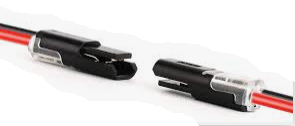
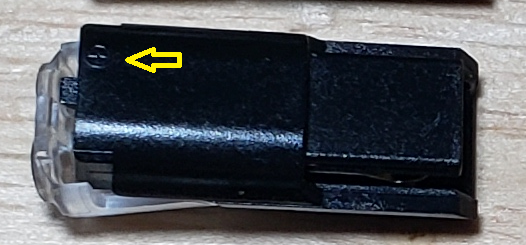
All of mine are opposite from this marking. Boo!
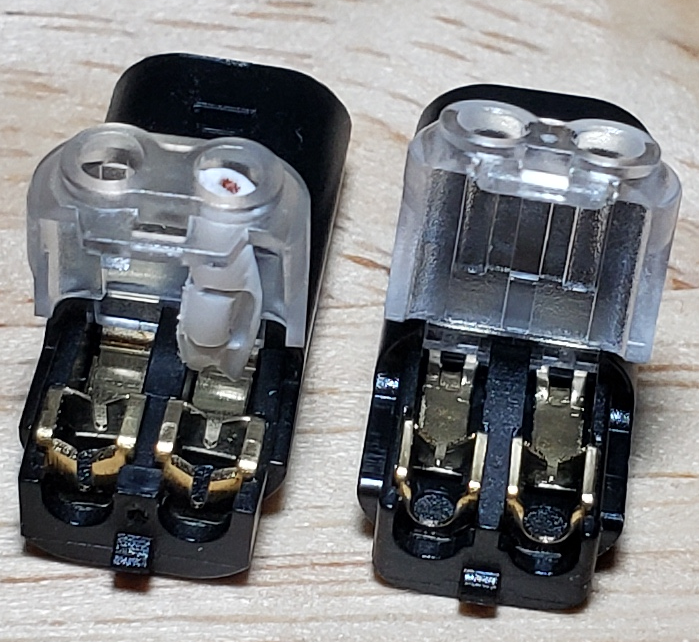
The one on the left has two IDC openings and a stronger support that ends up smashing the insulation. The one on the right only has one IDC and the opening works well with my wire.
They are NOT perfect!
- The first ones I bought had no polarizing markings, so I went with the picture in the advertisement shown above. The later ones had a + mark on them in the opposite polarity than all of my current connections. I looked back and depending on where you look, the red wire can be on either side of the connector. (It’s really important that all of them have the same polarity.)
- I had to figure out how to load the wire into them without damaging the connector.
- It’s actually tricky to get the wire onto all four of the IDC terminals inside it.
- They have a very limited wire size, 22-20 works best.
- There are at least two versions that have one or two IDC connections.
- They do hold together and I’ve not had an issue with the connection between them.
- I LOVE how small they are and how they have a good “Snap” connection.
The next item was twin lead wire that the connectors could use.
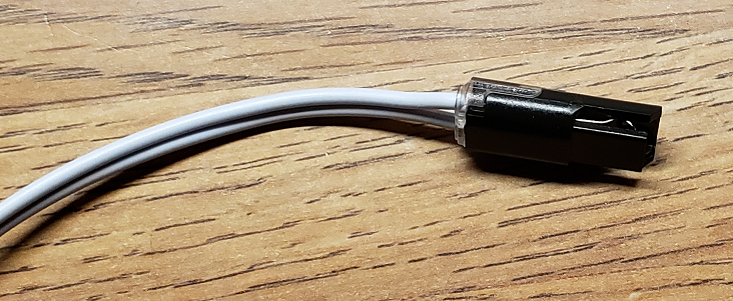
This picture is severely enlarged.
I happened on wire that was used for garage door openers. The wire is normally run to the two sensors at the bottom of the garage door opening.
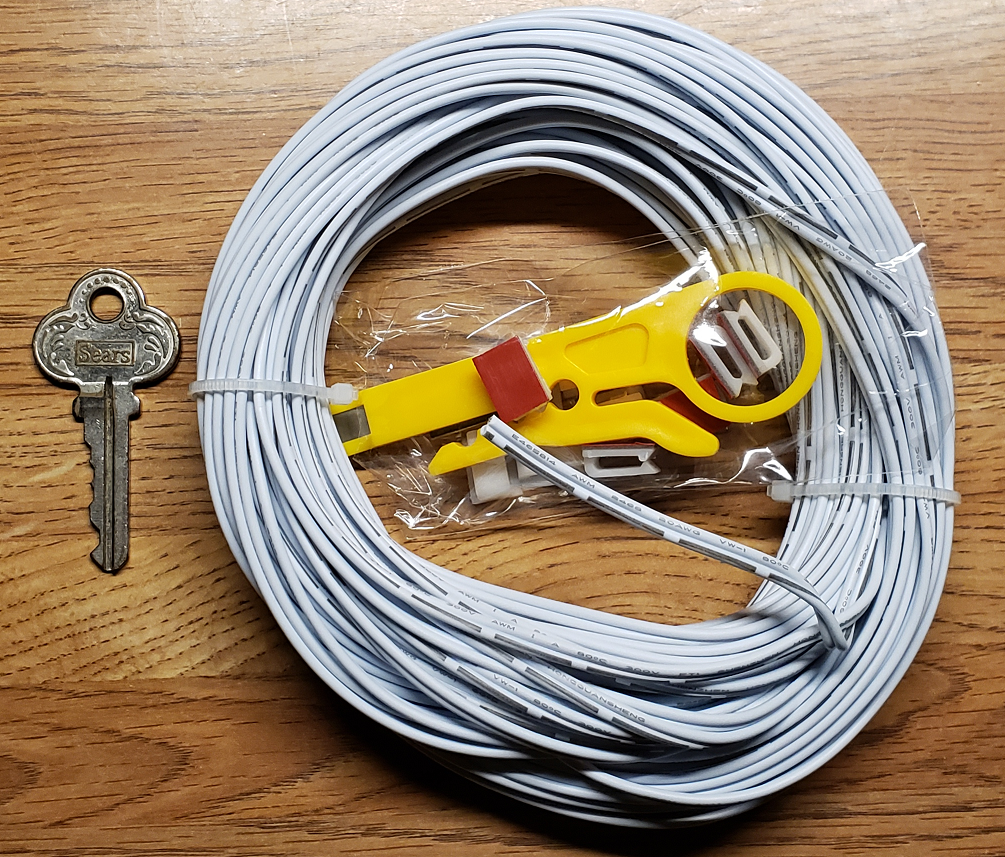
It’s available in over one-hundred-foot lengths, 20AWG and inexpensive!
(In 2026 the product changed to cheaper Copper Covered Aluminum.)
Most power supplies also use very similar wire that is clearly marked. (Usually black wire) They are NOT consistent on which wire is positive/negative. For my purposes I chose the dark bar wire as positive since 80% of the power supplies are similarly marked.
The third component was the USB power supply with connector.
I’ve seen these inexpensive China power supplies for years, but getting the DC to them was the more difficult problem. Now that I have a connector and wire, they are looking much more inviting.
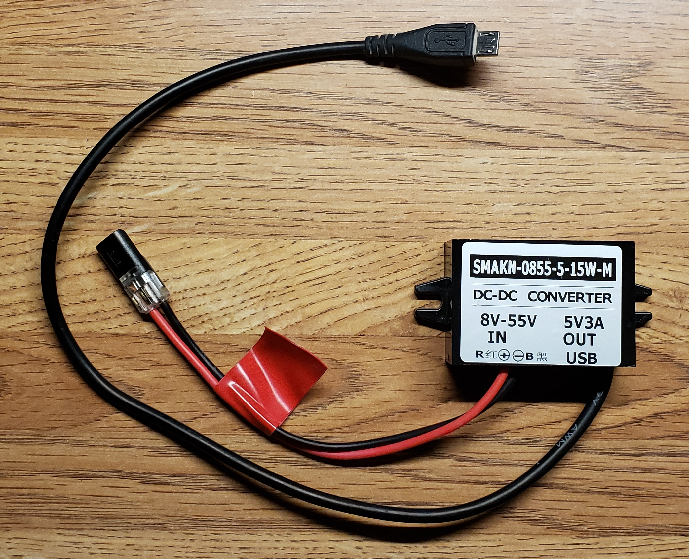
They have varying voltage requirements and most of them provide 3 amps with a very efficient switching power supply which is sufficient for all of the devices I currently have. (They typically do not get warm at all unless they are about to fail !) This particular one can take 55Volts which is insane for a 15W load. (A modern golf cart is 56 volts.) The voltage drop at 2A on 100 foot of 20AWG wire is roughly 4 Volts which would still provide 16W (3A@5V) of power at 12V. Raising the voltage to 14V drops the current to 1.5A and 18V drops the current to a little over 1A.
I had thought of increasing the AWG of the wire.
I had a 40Ft run to a 12V light bulb that was protecting a garden water faucet in Pahrump Nevada. The light bulb draws about an amp of current so the voltage at the bulb was just a little over 9V. It was more expensive to buy 40Ft of 16AWG wire than a 14V power supply and not worry about the voltage drop. The same came to be true for multiple USB DC-DC converters. It was cheaper to raise the voltage than to purchase multiple 12V power supplies. I ended up with the majority of my devices running from a single 3A 18V power supply that powered my Amazon Echo Show.
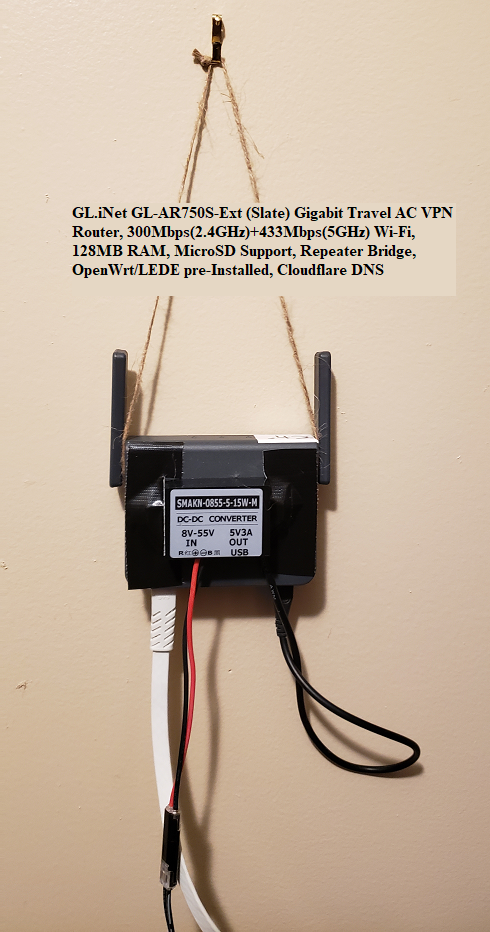
This wireless router can be mounted just about anywhere, and the 10W power requirements are so low that it could be run on one of the 24AWG pairs.